X01 Darts Rules
The most popular darts format. Count down from 501, 301, or 701 to exactly zero.
Overview
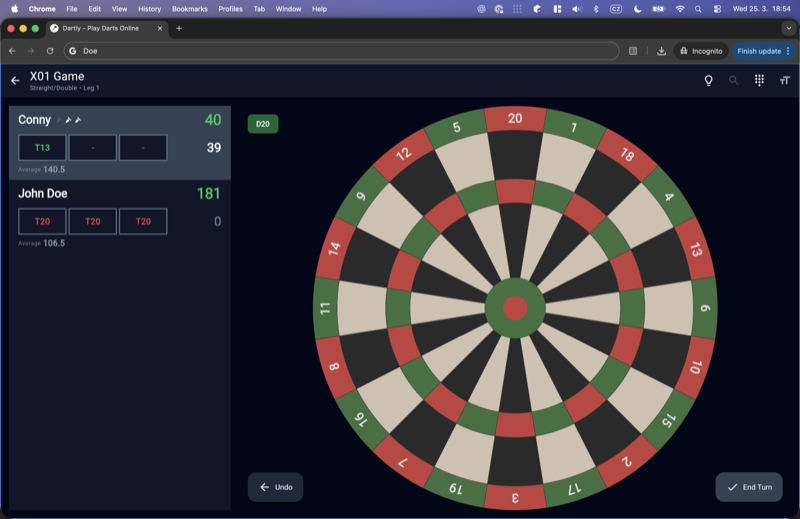
X01 is the most widely played darts game in the world and the standard format for professional tournaments including the PDC World Championship. Each player starts with a set score — most commonly 501 — and throws darts to reduce that score as quickly as possible. The first player to reach exactly zero wins the leg.
The “X” in X01 represents the starting digit: 301 for shorter games, 501 for the standard format, and 701 for longer matches. Dartly also supports custom starting scores for practice or casual play.
Game Setup
| Setting | Options |
|---|---|
| Starting Score | 301, 501 (default), 701, or custom |
| Players | 1 or more |
| Format | Single leg, best of N legs, or sets |
| Darts per Turn | 3 |
| In Option | Straight In, Double In, Master In |
| Out Option | Straight Out, Double Out, Master Out |
Basic Scoring
Each throw reduces the player's remaining score by the value of the dart. The dartboard is divided into 20 numbered segments, each with single, double (outer narrow ring), and triple (inner narrow ring) areas.
- Single: Face value of the segment (e.g., Single 20 = 20 points)
- Double: Segment value × 2 (e.g., Double 20 = 40 points)
- Triple: Segment value × 3 (e.g., Triple 20 = 60 points, the maximum single-dart score)
- Single Bull: 25 points
- Double Bull (Bullseye): 50 points
The maximum score in a single turn (3 darts) is 180, achieved by hitting three triple 20s. This is one of the most celebrated feats in darts.
In Options (Start Requirements)
The “in” option determines how a player may begin scoring.
Straight In
Any dart can start scoring immediately. This is the default and most common option. Your very first dart begins reducing your score.
Double In
Your first scoring dart must land in a double segment (the outer narrow ring) or the double bull. Until you hit a double, your throws do not count toward reducing your score, though your turn still progresses.
Master In
Your first scoring dart must land in either a double or a triple segment. Singles and the single bull do not count until you have “opened” with a double or triple.
Out Options (Finish Requirements)
The “out” option determines how a player must finish the game by reaching exactly zero.
Straight Out
Any dart that brings the score to exactly zero wins the leg. There are no restrictions on the finishing dart.
Double Out
The most common competitive format. The final dart that reduces the score to zero must land in a double segment or the double bull. For example, if you have 32 remaining, you must hit Double 16 to finish. This is the standard in PDC and WDF professional tournaments.
Master Out
The final dart must land in either a double or a triple segment. This provides slightly more flexibility than double out while still requiring precision.
Bust Rules
A “bust” occurs when a throw cannot legally finish the game. When a bust happens, the turn ends immediately and the player's score reverts to what it was at the start of that turn. All three darts from that turn are effectively erased.
A turn is a bust if:
- The throw would reduce the score below zero
- The throw would leave exactly 1 with double-out or master-out (since no double or triple equals 1)
- The throw reduces the score to exactly 0 but on the wrong multiplier (e.g., hitting a single when double-out is required)
Example: You have 32 remaining with double-out. You throw Single 20 (score becomes 12), then Single 10 (score becomes 2). Your third dart hits Single 2, reaching 0 — but it was not a double. This is a bust. Your score returns to 32.
Legs and Sets
X01 matches can be played in several formats to determine the overall winner.
| Format | Description | Example |
|---|---|---|
| Single Leg | One game decides the winner | First to check out wins |
| Best of N Legs | First to win majority of legs | Best of 5 = first to win 3 |
| Sets | Legs grouped into sets; best of N sets | Best of 5 sets, each set best of 3 legs |
In multi-leg matches, the starting player rotates each leg. The first leg starts with the designated first player, the second leg with the next player, and so on. In single-leg mode with multiple players, the first player to check out gets first place, and the match does not end there — the remaining players keep throwing to determine the other places, ranked by their lowest remaining score, until everyone has checked out or the leader chooses to end the game early.
Checkout Suggestions
When your remaining score is 170 or less, Dartly displays professional checkout suggestions — the optimal combination of darts to finish the leg. These are based on checkout tables used by professional players on the PDC tour.
The checkout chart covers all 161 possible finishes from 2 to 170 with double-out. The highest possible checkout is 170 (Triple 20, Triple 20, Double Bull). Eight scores between 159 and 169 are known as bogey numbers and cannot be finished in three darts: 159, 161, 162, 163, 165, 166, 168, and 169.
View the full checkout chart with all 161 finishes.
Confirmation Mode
Confirmation Mode is an optional setting you can turn on when creating a game, or toggle mid-game from the top bar. Tapping the dartboard opens a magnified 1.5× overlay showing the segment you hit, its two neighbors, and the Bull — tap the correct segment to confirm the score, or tap outside the overlay to cancel with nothing scored. It's especially useful on small screens for telling apart close segments such as Double 18 vs Triple 18 or Double 20 vs Triple 20. Misses are always registered immediately and skip the confirmation step.
Strategy Tips
- Target Triple 20: The most efficient scoring area. Three Triple 20s scores 180 — the maximum possible turn. Even experienced players primarily aim here during the scoring phase.
- Know your finishes: Familiarize yourself with common checkouts, especially for scores under 100. Knowing that 76 finishes with Triple 20, Double 8 saves thinking time and improves consistency.
- Leave yourself a preferred double: As you approach a finish, plan your throws to leave a comfortable double. Most professionals prefer Double 16 because if you miss inside (hitting Single 16), you leave Double 8, and if you miss that, Double 4 — a manageable “downward path”.
- Avoid busting: When close to finishing, be aware of which throws would cause a bust. Sometimes it is safer to score less and leave a clean double than to risk busting on an aggressive throw.
Related Games
Related Articles
Play X01 Now
Start a 501 game with professional checkout suggestions. No download needed.
Open Dartly App