X01 Checkout Strategy: The Complete Guide to Finishing
Checkout charts tell you what to throw. This guide explains why, and how to think about finishing like a professional player.
In a standard 501 match with double-out rules, the average club player takes between 18 and 24 darts to reach a checkout range. The professional takes 12 to 15. But here is the part that surprises most people: the gap between amateurs and professionals is often wider on the checkout than it is on the scoring. A club player who averages 50 might hit 20% of their double attempts. A PDC tour player averaging 95 hits around 40-45%. That difference in finishing efficiency is where matches are won and lost.
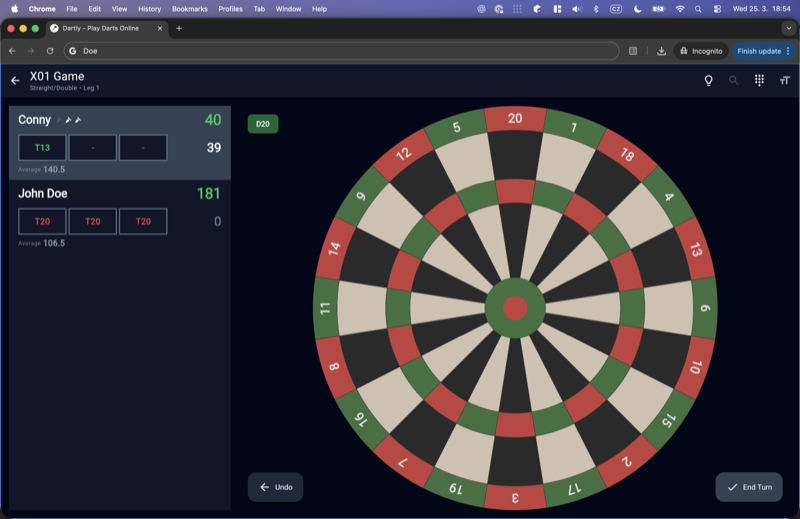
This article is not a checkout chart — you can find our complete checkout chart here. This is a guide to the strategic thinking behind checkouts: which doubles to prefer, how to set up your finishes, and how to manage the mental pressure of match darts.
The Anatomy of a Double
Before discussing strategy, it helps to understand the physical geography of the doubles ring. The doubles ring is the outermost scoring band of the dartboard, roughly 8mm wide. Each double segment covers an arc of 18 degrees. The wire separating adjacent doubles is about 1.5mm thick. This means your target area is genuinely tiny — about 8mm deep and roughly 30mm wide for each segment.
When you miss a double, one of four things happens: the dart lands in the single segment inside the double (you score the single value), it lands in the adjacent double (you score the wrong double), it falls outside the board entirely (zero), or it catches the wire and bounces out (zero). The first outcome — landing in the single — is by far the most common miss. This is why the value of the single behind a double matters enormously for strategy.
Why D16 Is the Most Forgiving Double
Ask any professional darts player which double they prefer, and most will say D16 (32). The reason is mathematical, not sentimental. D16 sits in a unique position on the board: if you miss inside and hit single 16, you leave yourself 16 — which is D8. If you then miss D8 inside, you leave 8 — which is D4. Miss D4 inside, you leave 4 — which is D2. Miss D2 inside, you leave 2 — which is D1.
Compare this to D20, which many players instinctively prefer because 20 feels like the "best" number. If you miss D20 inside and hit S20, you leave 20 — which is D10. Miss D10 inside, you leave 10 — D5. Miss D5 inside, you leave 5, which is not a double. You need S1 to leave D2, or S3 to leave D1. The safety chain breaks after just two misses.
D16 also has favorable neighbors. On a standard board, D16 sits between D8 and D7. If your dart drifts left and catches D8, you leave yourself on zero if you needed 16, or on a manageable even number from other starting positions. D7 is less useful, but the odds of drifting far enough to hit an adjacent double are lower than missing inside.
The D20 vs. D16 Debate
Despite the mathematical argument for D16, D20 remains the most attempted double on the PDC tour. Why? Because professional players factor in more than just miss recovery.
First, many checkout paths naturally arrive at 40 (D20). From 501, a common scoring pattern leaves the player on 40 without needing a setup shot. Redirecting to 32 would require deliberately scoring differently, which can mean sacrificing points earlier in the leg. For a professional whose checkout percentage on any double exceeds 40%, the cost of scoring less to reach a preferred double outweighs the benefit of a slightly better miss-recovery chain.
Second, D20 is at the top of the board, near T20 — the area where professionals spend most of their time. Their muscle memory for that section of the board is stronger than for the D16 area (lower left). Familiarity breeds accuracy.
Third, at the professional level, the difference in checkout percentage between doubles is small. PDC statistics show that the top players hit D20 at roughly 38-42% and D16 at roughly 40-44%. The gap exists but is narrow enough that other factors dominate.
For amateur players, however, the D16 advantage is more pronounced. If your double hit rate is 15-25%, you will miss inside more often, and the cascading recovery of D16 → D8 → D4 saves you far more frequently than D20 → D10 → D5. The lower your checkout percentage, the more D16 benefits you.
Setup Shots: The Art of Leaving the Right Number
A setup shot is a deliberate throw intended not to check out, but to leave you on a preferred double. This is where checkout strategy separates thoughtful players from players who simply throw at whatever remains.
Common setup scenarios
Left on an odd number: You cannot finish on an odd number in double-out. You need to hit an odd single to leave an even number. The question is which odd single. If you have 35 remaining, you could throw S3 to leave D16 (32), or S19 to leave D8 (16), or S15 to leave D10 (20). The experienced player throws S3 to reach the D16 corridor.
Left on a number just above a double: If you have 41 remaining, you need to throw S9 (leaves D16) rather than S1 (leaves D20). If you have 45, throw S13 to leave D16, not S5 to leave D20. These are the decisions that add up over a match.
Left on a high even number: If you have 76 remaining with two darts, you could throw T20 to leave D8 (16), or T16 to leave D14 (28). The T20 option is better because D8 is in the D16 cascade. If you have 82, throw T14 to leave D20 (40) or single bull (25) to leave 57 — which is awkward. Prefer the route that leaves a clean, familiar double.
The key numbers to memorize
Rather than memorizing an entire checkout chart, focus on the most common leaves and their best setups. These ten leaves cover the majority of real-game situations:
| Remaining | Best Shot | Leaves | Why |
|---|---|---|---|
| 32 | D16 | — | Favorite double, best cascade |
| 40 | D20 | — | Most common checkout on tour |
| 36 | D18 | — | Strong double, miss inside leaves S18 (D9) |
| 35 | S3 | D16 | Sets up the D16 cascade |
| 41 | S9 | D16 | Preferred over S1, D20 |
| 45 | S13 | D16 | Routes to D16 |
| 50 | S18 | D16 | Or S10, D20 — both valid |
| 60 | S20 | D20 | Natural, comfortable shot |
| 80 | T20 | D10 | Maximum scoring, clean double |
| 100 | T20 | D20 | Standard professional checkout |
Managing Your Score: Thinking Three Darts Ahead
Advanced checkout strategy does not start when you reach a checkable number. It starts two or three visits before. The concept is called "score management" and it means occasionally sacrificing a few points to position yourself on a better checkout.
Imagine you have 181 remaining. With two perfect visits of T20, T20, T20 you would score 180 and leave 1 — impossible to check out. Even 180 + any single leaves you in trouble. The experienced player recognizes this and deliberately adjusts. Scoring 139 (T20, T19, D11 area) instead of 140 (T20, T20, D10) on the previous visit might leave a better checkout this visit.
This kind of forward planning is rare in amateur play and nearly universal in professional play. When you hear commentators say a player is "on a finish," they are acknowledging that the player has managed their score to arrive at a number they know how to handle. It was not luck. It was arithmetic done three darts in advance.
For practical purposes, the numbers to avoid leaving are: 169, 168, 166, 165, 163, 162, 161, 159 (the bogey numbers — impossible to check out in three darts), and numbers like 99, 101 without a clean two-dart path. If your scoring visit would leave you on a bogey number, throw one fewer point deliberately. Leaving 160 (T20, T20, D20) is vastly better than leaving 161 (no checkout).
The Psychology of Finishing
Checkout situations carry a unique psychological burden. You have worked for 12 or 15 darts to reach this point. You know the math. You know the target. And suddenly, a 8mm-wide strip of board feels like it has shrunk to the width of a wire.
The first principle of checkout psychology is to treat the double like any other dart. It is the same throwing motion, the same distance, the same board. The only thing that changes is the meaning you assign to it. This is, of course, much easier said than done. But the underlying technique is: redirect your focus from the outcome (winning the leg) to the process (executing a good throw at a specific target).
The second principle is pace. Many players rush their doubles, throwing faster than they did during scoring. The urgency is understandable — you want to close it out before the moment passes. But faster throws are less controlled throws. Maintain the same rhythm. Use your pre-throw routine. Take the same time you always take.
The third principle is to plan your recovery before you throw. If you know that a miss inside on D16 leaves you D8, you have already accepted the miss and have a plan. This removes the catastrophic feeling of missing. You are not "failing to check out." You are "moving to your backup double." The reframe is subtle but powerful.
Common Checkout Mistakes
After years of watching amateur darts, certain mistakes appear repeatedly. Recognizing them is the first step to avoiding them.
Going for the big finish instead of the smart finish
You have 170 remaining with three darts. The temptation to go T20, T20, bull for the maximum checkout is enormous. But 170 is the hardest checkout in darts. If you miss the first T20, you have almost certainly lost the opportunity. A wiser approach might be to score 130 this visit and leave yourself 40 (D20) for next turn. This is not cowardice; it is probability management.
Failing to set up doubles
You have 25 remaining. Many players throw at single bull (25) to try for the checkout, forgetting that in double-out, you need D12 (24) plus S1, or some other combination. Throwing S9 to leave D8, or S1 to leave D12, gives you a much higher chance of finishing on your next dart. Always know your setup shot before you throw.
Ignoring the bogey numbers
Leaving yourself on 159, 161, 162, 163, 165, 166, 168, or 169 is effectively giving your opponent a free turn. These numbers have no three-dart checkout. If your scoring visit would leave a bogey number, adjust by one or two points. Leaving 160 instead of 161 is the difference between a chance and no chance.
Switching doubles after every miss
You miss D16, so you try D8. You miss D8, so you try D4. This cascading approach makes sense with the D16 corridor, but some players randomly switch from D20 to D16 to D10 to D5, never building confidence or muscle memory on any particular double. If you have a preferred double, stay committed to it. Consistency in targeting builds the muscle memory that eventually produces a higher hit rate.
Building Your Checkout Percentage
Checkout percentage is the single most impactful statistic in competitive darts. A player who checks out 35% of their attempts will beat a player who checks out 20%, even if the second player has a higher three-dart scoring average. The math is unforgiving: every missed checkout gives your opponent another turn to finish first.
To improve your checkout percentage, practice doubles deliberately. Spend at least 30% of your practice time on doubles. Many players spend 90% of their time aiming at T20 and wonder why they cannot finish games. A simple drill: start at D1 and work clockwise around the board. Hit each double before moving to the next. Time yourself. Try to beat your previous time. This builds familiarity with every double on the board, not just your favorites.
Another effective drill is the "double start" game. At the beginning of each practice session, throw at D16 until you hit it. Then D8. Then D4. Then D2. This warms up your finishing arm and reinforces the D16 cascade that will serve you in real matches.
Putting It Into Practice
Checkout strategy is ultimately about preparation. Memorize your preferred checkouts for common leaves. Practice setup shots until they become automatic. Train your doubles with the same dedication you give to scoring. And when you step to the oche with a finish in sight, trust the process you have built. The double is just another target. Throw at it the way you throw at everything else — with a calm grip, a smooth motion, and a committed follow-through.
Try Dartly Free
Practice your checkouts with built-in checkout suggestions. Dartly shows you the optimal finish for every score from 2 to 170.
Open Dartly App