10 Pro Tips to Improve Your Darts Average
Actionable techniques that separate casual throwers from consistent scorers. Whether your average sits at 30 or 60, these fundamentals will move the needle.
Every darts player hits a plateau. You throw regularly, you know the rules, you can occasionally land a 140 — but your average stubbornly hovers in the same range, week after week. The difference between a 40 average and a 60 average is rarely talent. It is almost always technique, consistency, and deliberate practice.
These ten tips are drawn from coaching principles used at PDC academies, BDO training camps, and by amateur players who have documented their improvement journeys in detail. None of them require expensive equipment. All of them require patience.
1. Build a Repeatable Stance
Your stance is the foundation of every throw. If your body position shifts from dart to dart, your release point shifts too, and your grouping suffers. The goal is not to find the "perfect" stance — it is to find your stance and repeat it identically every time.
Stand with your dominant foot forward, angled roughly 45 to 90 degrees to the oche. Your weight should favor the front foot — around 60-70% — with your rear foot providing balance. Many coaches recommend that your front foot, hip, shoulder, and elbow form a line pointing at the target. This alignment reduces the number of variables your brain has to manage during the throw.
The most common beginner mistake is leaning too far forward during the throw. This shifts your center of gravity and introduces a rocking motion that changes your release angle. If you find yourself losing balance after releasing the dart, you are leaning too far. Plant yourself solidly and let your arm do the work.
2. Find Your Natural Grip
Grip is deeply personal. Phil Taylor used a relaxed four-finger grip. Gary Anderson uses three fingers placed well forward on the barrel. Michael van Gerwen grips further back. There is no universally correct grip, but there are principles that apply to all of them.
First, the dart should rest naturally in your hand without tension. If your knuckles are white or your fingers are pressing hard, you are gripping too tightly. A tight grip restricts the smooth release that accurate throwing demands. Think of holding a small bird: firm enough that it cannot fly away, gentle enough that you do not hurt it.
Second, the number of fingers on the barrel matters less than their placement. Every finger touching the dart should have a purpose. If a finger is just resting there without contributing to control or release, remove it. Extra contact points increase the chance of an inconsistent release.
Third, your grip should allow the dart to leave your fingers cleanly at the point of release. If the dart wobbles significantly in flight, experiment with moving your fingers slightly forward or back on the barrel. A well-released dart should fly with minimal oscillation.
3. Master the Throwing Motion
The darts throw is fundamentally an elbow hinge. Your upper arm stays relatively still, anchored at or near your side. Your forearm pivots at the elbow, accelerating the dart forward, and your wrist provides the final snap. The fewer moving joints you involve, the fewer variables can introduce error.
The motion breaks into four phases: stance, drawback, acceleration, and follow-through. During drawback, bring the dart back smoothly until your hand approaches your cheek or jaw line. The exact position depends on your natural mechanics, but it should be the same every time. During acceleration, drive your forearm forward in a smooth arc. The release happens naturally when your hand opens at the top of the arc — do not try to "throw" the dart at a specific moment. Let it go.
One drill that dramatically improves consistency: throw 50 darts aiming only at the T20, but focus entirely on making each throw feel identical. Do not watch where the darts land. Close your eyes after release if it helps. The goal is building muscle memory for a repeatable motion, not hitting the target. Accuracy follows consistency, never the reverse.
4. Develop a Pre-Throw Routine
Watch any professional darts player and you will notice they do the same thing before every single dart. Some tap the dart against their chin. Some take exactly two practice aim-swings. Some pause for a fixed count. This is not superstition — it is a reset mechanism that signals the brain to enter a focused state.
A pre-throw routine serves two purposes. First, it gives you a consistent physical starting position. If you always begin with the dart at the same point beside your eye, your throw starts from a known position every time. Second, it creates a mental trigger. The routine tells your subconscious: "We are about to throw a dart now." Over thousands of repetitions, this trigger builds an automatic connection between the routine and the throwing motion.
Keep your routine short — under 5 seconds. A long routine slows the game, annoys opponents, and gives your conscious mind too much time to interfere with what should be an automatic process.
5. Warm Up Before Every Session
Would you run a race without stretching? Throwing darts cold is a recipe for poor early performance, which often spirals into frustration for the entire session. A proper warm-up takes 5 to 10 minutes and pays for itself immediately.
Start by throwing at large targets. The entire 20 segment, not the treble. The bullseye area, not the double bull. Your muscles need time to calibrate. Spend the first 2-3 minutes simply getting your arm loose and your grouping dialed in. Then narrow your focus to smaller targets: treble 20, then treble 19, then doubles.
Many league players arrive just before their match, throw three darts at the board, and start playing. They spend the first leg of their match effectively warming up, handing their opponent an easy lead. Arrive 10 minutes early. It matters.
6. Control Your Breathing
Breathing is the most overlooked aspect of darts technique. When you hold your breath or breathe shallowly, your muscles tense, your hand tightens, and your throw becomes jerky. When you breathe slowly and rhythmically, your body stays relaxed and your release stays smooth.
The simplest approach: breathe in as you draw back, breathe out as you throw. The exhale relaxes your chest and shoulders at exactly the moment you need them relaxed. Some players prefer to throw at the natural pause between exhale and inhale, when the body is at its most still. Experiment to find what works for you, but be conscious of your breathing rather than leaving it to chance.
This becomes especially important during pressure moments — match darts, checkouts, decisive legs. Under stress, the body naturally tenses and breathing becomes shallow. A deliberate deep breath before your checkout attempt can be the difference between a smooth release and a snatched throw.
7. Commit to Your Follow-Through
Follow-through is the single most diagnostic element of a darts throw. After releasing the dart, your arm should continue its natural arc until your hand is pointing at the target with fingers extended. Hold this position for a beat. If your hand finishes pointing at the target, your throw was likely on line. If it veers left or right, something went wrong in the release.
A common fault is "snatching" — pulling your hand back immediately after release, as if catching something. This usually indicates tension in the grip or a conscious attempt to steer the dart during release. Both destroy accuracy. The dart has already left your hand. Your follow-through cannot change its trajectory. But a good follow-through is evidence that everything before it was correct.
Practice this by throwing at a target and holding your follow-through position until the dart hits the board. Use the position of your hand as feedback. Over time, you will develop an intuitive sense of whether the throw was good before the dart even arrives.
8. Aim with Strategy, Not Just Hope
Many recreational players aim at T20 on every visit because that is what the professionals do. But professionals average over 95. If your average is 45, T20 is not your optimal target.
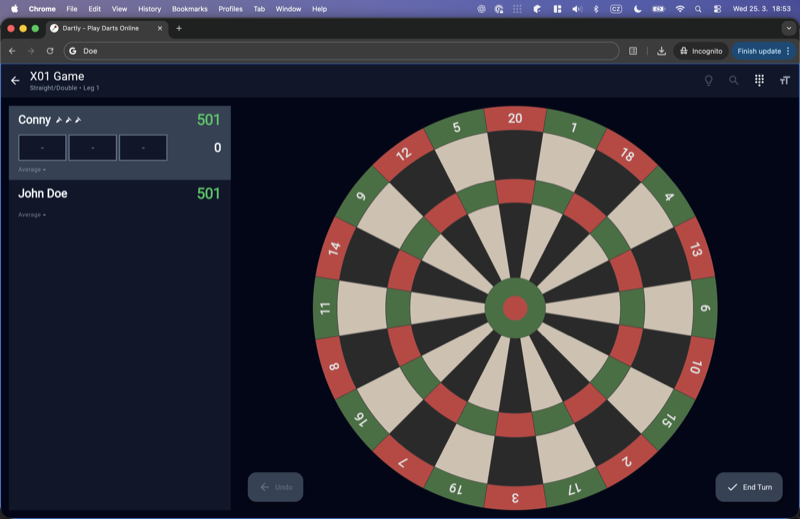
Consider the geography of the board. T20 sits between segments 1 and 5. A miss left or right often yields a single 1 or single 5 — a catastrophic drop from the 60 you wanted. T19, by contrast, sits between 7 and 3. A miss still gives you reasonable single scores. And T19 itself is worth 57, only 3 points less than T20.
For players averaging below 50, the optimal strategy is often to aim at the treble 19 or even the left-center of the board where misses cluster around higher single values. As your grouping tightens and you consistently hit what you aim at, T20 becomes the correct choice. Match your ambition to your current ability.
9. Strengthen Your Mental Game
Darts is played between the ears as much as at the oche. A missed double in leg one should not affect your throw in leg three, but for most players it does. The mental game is what separates players who perform in practice from players who perform in competition.
The core principle is simple: throw each dart as an independent event. The previous dart is gone. The score does not exist until you step up to throw. This sounds like motivational poster material, but it is a trainable skill. Every time you catch yourself dwelling on a miss, consciously reset. Take a breath, run your pre-throw routine, and focus on the process of this dart, not the outcome of the last one.
Visualization also helps more than most players expect. Before stepping to the oche, picture the dart landing where you want it. Not vaguely — see the specific wire, the specific segment. Top athletes across every sport use visualization, and darts is no exception. Spend 30 seconds before each match mentally placing darts exactly where you want them.
Finally, accept that bad darts happen. Even Michael van Gerwen has 60-point visits. The difference is that he does not let a bad visit become a bad leg. Emotional control is not about suppressing frustration — it is about preventing frustration from corrupting your technique.
10. Track Your Progress Systematically
You cannot improve what you do not measure. At minimum, track your three-dart average over every session. This single number tells you more about your game than any subjective feeling. If you think you are improving but your average is flat, you are not improving. If you feel like you are struggling but your average is climbing, your standards are rising faster than your play — which is actually a good sign.
Beyond the average, track your checkout percentage. Many players have a respectable scoring average but convert fewer than 20% of their double attempts. That single weakness can cost you two or three legs per match. If your checkout percentage is below 30%, dedicated double practice will improve your results faster than any amount of T20 practice.
Record your practice sessions and match results. After a month, review the data. You will find patterns: perhaps you score well in the first three legs but fade in the fourth, suggesting a stamina or focus issue. Perhaps your T20 percentage is high but your T19 is weak, indicating an alignment issue on that side of the board. Data turns vague feelings into specific, actionable problems.
Putting It All Together
Improvement in darts is not dramatic. You will not jump from a 40 average to an 80 average in a month. But consistent application of these fundamentals — a stable stance, a relaxed grip, a repeatable motion, a clear routine, proper warm-up, controlled breathing, committed follow-through, smart targeting, mental discipline, and data tracking — will produce steady, measurable improvement over weeks and months.
The players who improve fastest are not the most talented. They are the most deliberate. They practice with intention, they track their numbers, and they focus on process over outcome. Pick two or three tips from this list that address your weakest areas, work on them for a month, and measure the results. Then move to the next two or three. Small improvements compound.
Try Dartly Free
Practice what you've learned with our free darts scoring app. Track your averages and watch your improvement over time.
Open Dartly App