Killer Darts Rules
Elimination game in two phases. Claim your number, then attack opponents.
Overview
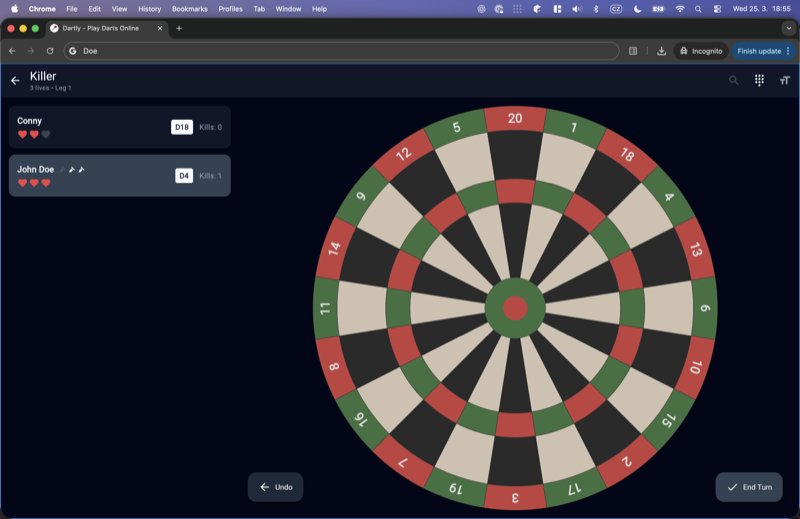
Killer is an exciting elimination darts game played in two distinct phases. In the first phase, each player claims a unique number by hitting its double. In the second phase, players attack opponents by hitting the doubles of their claimed numbers to take away lives, while defending their own number to regain lost lives. The last player standing wins.
Killer is best played with 3 to 6 players, making it an ideal pub game and one of the most popular social darts formats. The game rewards accuracy on doubles, strategic targeting, and awareness of which opponents pose the greatest threat.
Game Setup
| Setting | Value |
|---|---|
| Starting Lives | 3 (customizable from 1 to 5) |
| Players | 2 or more (ideal: 4–6) |
| Format | Single leg or best of N legs |
| Darts per Turn | 3 |
Phase 1: Number Selection
Before the main game begins, each player must claim a unique number from 1 to 20. To claim a number, a player must hit the double of that number. Bull (25) cannot be selected as a killer number.
Players take turns throwing up to 3 darts per turn. A player's turn continues until they hit the double of an unclaimed number (which claims that number) or until they use all 3 darts without claiming a number. If a player hits the double of a number that another player has already claimed, the throw does not count and the dart is wasted.
Example: Player A throws at Double 16 and hits it. Number 16 is now claimed by Player A. Later, Player B throws at Double 16 — it does not count because 16 is already taken. Player B must aim for a different double.
Once all players have claimed a number, Phase 2 begins.
Phase 2: Playing
In the playing phase, each player throws 3 darts per turn. The objective is to eliminate opponents by reducing their lives to zero, while keeping your own lives intact.
Attacking
To attack an opponent, hit the double of their claimed number. Each double hit removes one life from that opponent. Only doubles count — singles and triples on an opponent's number have no effect.
You can target multiple opponents in a single turn if you hit the doubles of different players' numbers. For example, if Player B owns number 8 and Player C owns number 14, hitting D8 and D14 in the same turn removes one life from each of them.
Defending
To defend, hit the double of your own claimed number. Each hit on your own double restores one life. However, you cannot exceed your starting number of lives. If you started with 3 lives and currently have 3, hitting your own double has no effect.
Elimination
When a player's lives reach zero, they are eliminated from the game. Eliminated players are assigned a finish position based on the order they were eliminated — the first player eliminated finishes last, and so on. Eliminated players no longer throw darts, and their number can no longer be targeted.
Important: Only doubles affect lives. If Player A's number is 16 and someone hits Single 16 or Triple 16, Player A's lives are unaffected. You must hit the double ring of the opponent's number.
Win Condition
The last player with lives remaining wins the leg. The winner is assigned position 1, and all other players are ranked by elimination order.
In a best-of-N-legs format, a new leg resets all players to full lives and returns to Phase 1 (number selection). The starting player rotates with each new leg to ensure fairness.
Confirmation Mode
Confirmation Mode is an optional setting you can turn on when creating a game, or toggle mid-game from the top bar. Tapping the dartboard opens a magnified 1.5× overlay showing the segment you hit, its two neighbors, and the Bull — tap the correct segment to confirm the score, or tap outside the overlay to cancel with nothing scored. Since only doubles matter in Killer, it's a handy way to make sure you really hit your target's double and not a neighboring number. Misses are always registered immediately and skip the confirmation step.
Strategy Tips
- Choose your number wisely: During Phase 1, consider claiming a number whose double you are confident hitting for defense. Some players prefer numbers they rarely aim at so opponents are less practiced at their double.
- Target the leaders: Focus on players with more lives first. Eliminating a player who has many lives removes a bigger threat and reduces the number of opponents.
- Defend when low: If you are down to 1 life, it may be worth spending a dart on your own double to restore a life before continuing to attack.
- Spread your attacks: Reducing multiple opponents to low lives creates pressure on everyone. A player with 1 life must play more carefully.
- Remember the doubles: Killer is fundamentally a doubles game. Use it as practice to sharpen your accuracy on the double ring.
- Watch the board: Keep track of which numbers belong to which players. Knowing the current lives of every opponent helps you make smarter targeting decisions.
Example Round
Suppose four players have completed Phase 1:
| Player | Killer Number | Lives |
|---|---|---|
| Alice | 16 | 3 |
| Bob | 8 | 3 |
| Charlie | 20 | 3 |
| Dana | 11 | 3 |
Alice throws: D20 (Charlie loses 1 life), S8 (no effect — not a double), D11 (Dana loses 1 life). After Alice's turn, Charlie has 2 lives and Dana has 2 lives.
Related Games
Related Articles
Play Killer on Dartly
Customizable lives, automatic tracking, and full statistics. Free, no download needed.
Play Now