Hit and Beat Darts Rules
Elimination game where players set and chase target scores. Four variants and optional bonus perks to choose from.
Overview
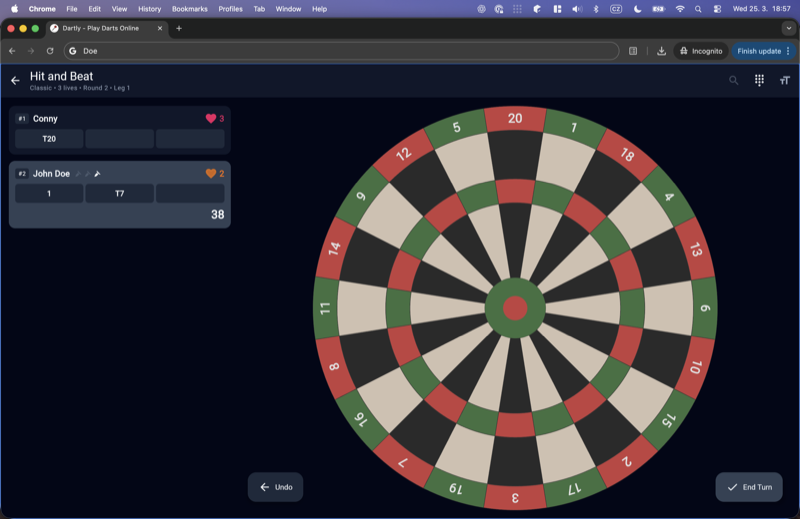
Hit and Beat — also known as "Chase" or "P\u0159esko\u010dka" (Czech) — is an elimination game built around a simple idea: one player sets a target score and the next player must beat it. Fail to beat the target and you lose a life. Lose all your lives and you're out. The last player standing wins.
The game creates natural drama as targets escalate and players push their luck. It works best with 3 to 5 players, though it can be played with 2 or more. Four variants — Classic, Shuffle, Chase, and Chase Ultimate — offer different levels of unpredictability, and optional advanced settings can layer bonus perks on top.
Game Setup
| Setting | Value |
|---|---|
| Starting Lives | 3 (customizable from 1 to 10) |
| Players | 2 or more (ideally 3–5) |
| Format | Single leg or best of N legs |
| Darts per Turn | Up to 3 (turn can end early) |
| Random Order | Optional (enables Shuffle, Chase, or Chase Ultimate) |
Game Phases
The game alternates between two phases depending on whether a target score is currently active.
Phase 1: Setting the Target
When there is no active target (target = 0), the current player throws darts to establish one:
- The player throws up to 3 darts, trying to score more than 0
- If score > 0: That score becomes the new target. The phase switches to Chasing and the next player must beat it.
- If score = 0 (all 3 darts miss): The player loses a life. The target remains at 0 and the next player attempts to set a target instead.
Setting a target is relatively easy since any scoring dart will do. However, missing all three darts is a costly mistake — you lose a life without anyone even chasing.
Phase 2: Chasing the Target
When there is an active target, the current player must try to beat it (score strictly higher) using up to 3 darts. The turn ends either when all 3 darts have been thrown or when the target has been beaten.
Beating the Target (score > target)
- The player's score becomes the new, higher target
- No life is lost
- The next player must now chase this new, higher target
Matching the Target (score = target)
- The target resets to 0
- No life is lost (a neutral outcome)
- The next player enters Phase 1 to set a new target
Failing to Beat (score < target)
- The target resets to 0
- The player loses a life
- The next player enters Phase 1 to set a new target
Target Persistence Across Rounds
The target score carries over between rounds — it does not automatically reset when a new round begins. If the last player in a round beats the target and sets a new higher one, the first player in the next round must chase that target. The target only resets to 0 when a player matches it exactly or fails to beat it.
This persistence is important because it means a high target set at the end of one round can put immediate pressure on the first player of the next round.
Elimination
When a player's lives reach 0, they are eliminated from the game. Eliminated players receive a finish position based on elimination order (first eliminated = last place). Only active (non-eliminated) players continue to participate in subsequent rounds.
The game continues until only one player remains. That player is the winner.
Game Flow Example
A 3-player game with 3 lives each, showing the first few turns:
| Turn | Player | Phase | Score | Result |
|---|---|---|---|---|
| 1 | Alice | Setting | 45 | Target set to 45 |
| 2 | Bob | Chasing 45 | 60 | Beats it — target now 60 |
| 3 | Carol | Chasing 60 | 38 | Fails — loses a life (2 left), target resets |
| 4 | Alice | Setting | 26 | Target set to 26 |
| 5 | Bob | Chasing 26 | 26 | Matches exactly — no life lost, target resets |
Variants
Hit and Beat offers four variants that change how player order is determined between turns and rounds.
Classic
Players throw in a fixed rotation throughout the entire game. The order never changes, just like most traditional darts games. This is the most predictable variant and recommended for beginners.
Shuffle
After each complete round (every active player has thrown once), the player order is randomly shuffled. This adds an element of unpredictability — you never know who will have to chase a high target next.
Two important constraints apply to Shuffle:
- No back-to-back turns: The last player from the previous round cannot be the first player in the next round. This prevents anyone from playing two consecutive turns.
- Fixed rotation with 2 remaining: When only 2 players are left, the order becomes fixed (no more shuffling). This ensures a fair head-to-head finish.
Chase
Uses a continuously shifting queue of the next three players instead of shuffling once per round. After every single turn, the player who just threw drops off the queue and a new player is drawn at random from whoever is not already in it — so the same three names never overlap and nobody is skipped twice in a row without warning. Once three or fewer players remain in the game, the queue stops randomizing and settles into a fixed rotation among them.
Chase Ultimate
Works like Chase, but with the safety rail removed: the next player is drawn from all living players, duplicates allowed. The same player can be drawn again immediately, so it's possible to throw two turns in a row — or to get chased twice before anyone else even picks up a dart. Randomization never settles into a fixed rotation until only one player is left standing, making this the most chaotic variant.
Advanced Settings (Optional Bonus Perks)
Beyond the variant, Hit and Beat has eight optional advanced settings you can turn on when creating a game. All of them are off by default, all are independent of each other, and each works the same way regardless of which variant you picked.
| Setting | Effect |
|---|---|
| Penalize Exact Match | Hitting the target exactly costs a life instead of just resetting it. Off by default; turning it on makes the game noticeably harder. |
| Extra Life on Overshoot | Beat the target by at least a configurable amount (default 50) and you gain an extra life. There is no cap — your lives can climb above your starting total. |
| Initial Target to Beat | When a player is setting the target from zero, they must beat a configurable floor (default 30) instead of simply scoring above zero. Falling short of the floor costs a life. |
| Kill Streak Bonus | While you're the target setter, every opponent who fails to beat your target counts toward a kill streak. Reach the configured number of kills (default 3) and you gain an extra life; the streak then resets. |
| Bullseye Bonus | Hitting the Double Bull (50) while setting or beating the target grants an extra life. |
| Chase Streak Bonus | Beat the target several times in a row to earn an extra life once you reach the configured streak (default 3). Losing a life resets the streak. |
| Comeback Bonus | Beating or setting the target while on your very last life grants one extra life — once per leg. |
| Guardian Shield | Matching the target exactly banks a shield (up to 2) instead of triggering the exact-match penalty. A banked shield automatically absorbs your very next life loss. |
If both Guardian Shield and Penalize Exact Match are turned on, Guardian Shield wins: an exact match banks a shield instead of costing a life, unless you're already holding the maximum of 2.
Starting Player Rotation
In multi-leg matches, the starting player rotates between legs. The first leg starts with the designated starting player, the second leg with the next player in the order, and so on. Random ordering (in Shuffle, Chase, and Chase Ultimate) only happens within a leg, not between legs.
Confirmation Mode
Confirmation Mode is an optional setting you can turn on when creating a game, or toggle mid-game from the top bar. Tapping the dartboard opens a magnified 1.5× overlay showing the segment you hit, its two neighbors, and the Bull — tap the correct segment to confirm the score, or tap outside the overlay to cancel with nothing scored. It's especially useful for confirming a double bull hit when the Bullseye or Guardian Shield bonuses are on the line. Misses are always registered immediately and skip the confirmation step.
Strategy Tips
- Set moderate targets: When setting a target, a score around 40–60 is a good balance. Too low and the next player beats it easily, too high and the target will likely reset anyway when the chaser fails — but at the cost of their life, which benefits you.
- Watch the target escalation: Targets can escalate quickly as players beat each other. If the target reaches 100+, consider that failing costs you a life but also resets the pressure. Sometimes losing a life strategically is better than chasing an impossibly high target.
- Matching is underrated: Matching the target exactly is a neutral outcome — you lose nothing and the target resets. If you reach the target score with your first or second dart, you might consider carefully whether to throw your remaining darts (potentially overshooting and setting a high target someone else can fail on) or to stop if you already matched.
- Conserve lives early: In the early game when many players are active, there are more chances for targets to reset. Don't play too aggressively with your lives — outlasting opponents is more important than flashy scores.
- Go aggressive in the endgame: When only 2–3 players remain, every turn matters. Set high targets to pressure your opponents and aim for their elimination.
- Shuffle variant awareness: In Shuffle mode, pay attention to who went last. They can't go first next round, which means you might be next. Stay mentally prepared for your turn at any moment.
- Check the advanced settings before the first dart: If Guardian Shield or the Kill Streak / Chase Streak bonuses are enabled, matching the target exactly or stringing together beats is worth more than usual. If Penalize Exact Match is on and Guardian Shield is off, an exact match is dangerous rather than safe — know which rules are active.
Related Games
Related Articles
Play Hit and Beat Now
Choose Classic, Shuffle, Chase, or Chase Ultimate, with optional bonus perks and customizable lives. No download needed for the web version.
Play Now