Baseball Darts Rules
Nine innings of darts modeled after American baseball. Score runs by hitting the inning number.
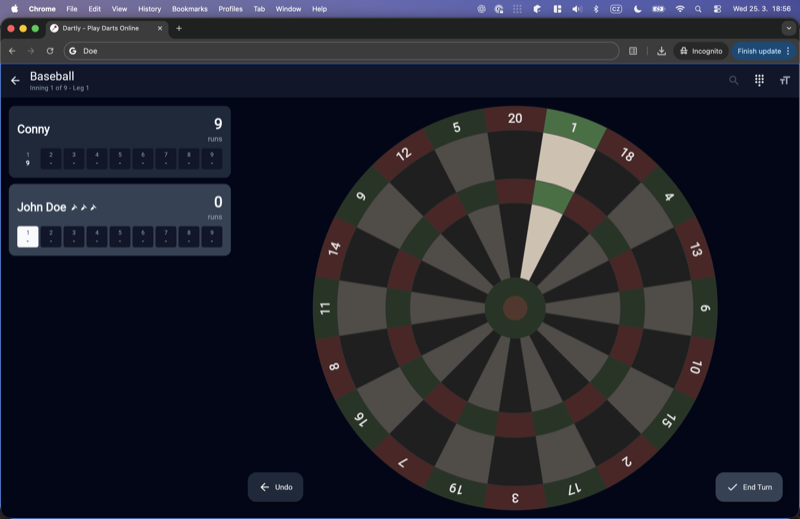
Overview
Baseball is a scoring game inspired by America's pastime. The game is divided into 9 innings, and each inning has a target number on the dartboard. Players take turns throwing 3 darts at the current inning's target, accumulating runs. The player with the most total runs at the end of 9 innings wins. If scores are tied, the game continues into extra innings until a winner emerges.
Baseball darts is easy to learn and works well for players of all skill levels. It's a popular choice for group games because everyone gets the same number of turns and the scoring is straightforward.
Game Setup
| Setting | Value |
|---|---|
| Innings | 9 (standard), with extra innings if tied |
| Players | 1 or more |
| Format | Single leg or best of N legs |
| Darts per Turn | 3 |
Innings and Scoring
Each inning targets the segment on the dartboard that matches the inning number. In Inning 1 you throw at segment 1, in Inning 2 you throw at segment 2, and so on through Inning 9.
Only darts that land on the current inning's number score runs. Darts that land on any other segment score nothing for that turn.
| Hit Type | Runs Scored |
|---|---|
| Single | 1 run |
| Double | 2 runs |
| Triple | 3 runs |
| Other segment | 0 runs |
The maximum score in a single inning is 9 runs (three triples). For example, in Inning 5, hitting Triple 5 with all three darts would give you 9 runs for that inning.
Game Flow
All players throw at the same inning before moving on to the next one:
- All players throw 3 darts at Inning 1 (segment 1)
- All players throw 3 darts at Inning 2 (segment 2)
- Continue through Inning 9 (segment 9)
- After all 9 innings, compare total runs to determine the winner
This format means every player has the same set of target numbers and the same number of opportunities to score, making the game inherently fair.
Scoring Example
Here is a sample 3-inning scoring comparison for two players:
| Inning | Target | Alice | Bob |
|---|---|---|---|
| 1 | Segment 1 | S1, Miss, D1 = 3 runs | Miss, Miss, T1 = 3 runs |
| 2 | Segment 2 | T2, S2, Miss = 4 runs | S2, S2, S2 = 3 runs |
| 3 | Segment 3 | Miss, Miss, Miss = 0 runs | D3, Miss, S3 = 3 runs |
| Total (3 innings) | 7 runs | 9 runs | |
After all 9 innings, the player with the highest total wins.
Tie Breaking — Extra Innings
If two or more players are tied after the standard 9 innings, the game continues into extra innings:
- Inning 10 targets segment 10
- Inning 11 targets segment 11
- Extra innings continue until the tie is broken
After each extra inning, if one player scored more runs than all others in that extra inning alone, that player wins the game outright — regardless of the cumulative totals from the earlier innings. If two or more players tie for the most runs in that extra inning, another extra inning is played. Since the dartboard has numbers up to 20, extra innings can theoretically extend up to Inning 20.
Win Condition
The player with the highest total runs after the 9 regular innings wins the leg. If the game goes to extra innings instead, the winner is whoever scores the most runs in the extra inning that finally breaks the tie — see Tie Breaking above. In a best-of-N-legs match, the first player to win the required number of legs wins the match.
The Perfect Game
A perfect game in Baseball darts is 81 runs — that's three triples in each of the 9 innings (9 runs × 9 innings). While theoretically possible, achieving a perfect game is extraordinarily rare and requires hitting the triple of every number from 1 through 9 with every single dart. Even professional players would struggle to accomplish this feat.
Starting Player Rotation
To keep multi-leg matches fair, the starting player rotates between legs. The first leg starts with the designated starting player, the second leg with the next player in the order, and so on. This ensures no single player always has the advantage of throwing first.
Confirmation Mode
Confirmation Mode is an optional setting you can turn on when creating a game, or toggle mid-game from the top bar. Tapping the dartboard opens a magnified 1.5× overlay showing the segment you hit, its two neighbors, and the Bull — tap the correct segment to confirm the score, or tap outside the overlay to cancel with nothing scored. It's especially useful on small screens for telling apart a single from a triple on the current inning's number. Misses are always registered immediately and skip the confirmation step.
Strategy Tips
- Focus on the triple: Since triples score 3 runs per dart, aiming for the triple segment gives you the best chance of a high-scoring inning. Even if you miss the triple, you may land a single for 1 run.
- Early innings matter less: Segments 1 through 3 are small and close together. Don't be discouraged by low scores in early innings — the larger segments (7, 8, 9) offer better opportunities to catch up.
- Stay consistent: Unlike elimination games, Baseball rewards steady performance. One great inning won't save you if you have several zeros. Try to score at least 1–2 runs every inning.
- Practice your lower numbers: Many players practice 20s and 19s for X01 but neglect lower numbers. In Baseball, you need accuracy across the entire 1–9 range.
- Watch your opponents: If you're behind heading into the final innings, take calculated risks and aim exclusively for triples. If you're ahead, even a single hit keeps you safe.
Related Games
Related Articles
Play Baseball Darts Now
Set up a Baseball game in seconds with automatic scoring, extra inning support, and full statistics. No download needed for the web version.
Play Now