Cricket Darts Strategy: Complete Guide for All Levels
Cricket is not just about throwing at 20. It is a tactical battle where board management, tempo control, and reading your opponent matter as much as accuracy.
Cricket occupies a unique space in darts. Unlike X01, where pure scoring ability dominates, Cricket rewards strategic thinking. A player with a lower treble hit rate can beat a better thrower by making smarter decisions about when to close numbers, when to score, and when to apply pressure. This is what makes Cricket endlessly interesting — and what makes understanding its strategy so valuable.
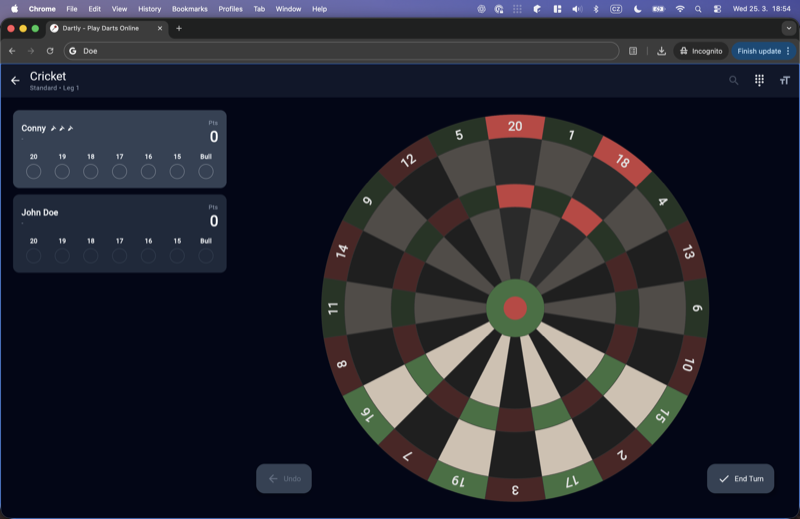
This guide covers standard Cricket, cut-throat Cricket, and the strategic principles that apply across all variants. For the basic rules, see our Cricket rules page. Here, we focus on how to win.
Opening Strategy: Where to Start and Why
The opening turns of a Cricket game set the tone for the entire leg. Your choice of which number to attack first reveals your strategy, applies pressure, and can establish a lead that compounds throughout the game.
The case for starting at 20
Most experienced Cricket players open with 20. The logic is straightforward: 20 is the highest-value number on the board. Closing it first gives you access to the most lucrative scoring segment. Every treble 20 you hit after closing scores 60 points against an opponent who has not closed 20 yet. That kind of point pressure forces your opponent to respond rather than pursue their own strategy.
Starting at 20 also carries a psychological message. It says: "I am going to play aggressively and score on you." Even if you do not hit three marks in your first turn, you have signaled intent. Your opponent must now decide whether to match you on 20 or pursue a different number, knowing they may be absorbing points.
The case for starting at 19 or 18
Some players prefer to start at 19, particularly if they feel more confident throwing at that section of the board. The T19 sits between segments 7 and 3, which means a slight miss still scores reasonable points in a different context. More importantly, if your opponent is committed to 20 and you close 19 first, you can score on 19 while they are still working on 20. The per-mark value difference between 20 and 19 is only 3 points (60 vs. 57 for a treble), but the tempo advantage of closing first can outweigh that.
Starting at 18 is rarer but has merit in specific situations. If you know your opponent always starts at 20, opening at 18 concedes the 20 battle entirely but gives you an unopposed number to close and score on immediately. The risk is that 18 scores less per mark, and your opponent may build a substantial lead on 20 before you can compensate.
The bull opening
Some aggressive players open with bull. The bull is worth 25 (single) or 50 (double), making it the second-highest-value target after 20. It is also the hardest to close because the target area is small. Opening with bull is a high-risk play: if you close it quickly (a double bull gives you two marks in one dart), you gain a powerful scoring number and a strong positional advantage. If you spend three darts and only get one mark, you have wasted a turn while your opponent closed 20.
The bull opening works best against opponents who you know will start at 20. While they spend their first turn on treble 20, you are working on the most difficult number on the board. If you manage two or three marks on bull in your first turn, you are ahead on tempo because your opponent will eventually have to face the bull — and they will find it just as difficult as you did.
The Score vs. Close Decision
The fundamental strategic tension in Cricket is the decision between scoring on an open number and closing a new number. This decision comes up constantly, and getting it right consistently is the hallmark of a strong Cricket player.
When to score
Score when you have a closed number that your opponent has not closed, and you are behind on points or want to build an insurmountable lead. The value of scoring is not just the points themselves — it is the pressure those points create. An opponent who is 100 points behind must either close your scoring number (defensive play) or score even faster on their own open numbers (risky play). Either response disrupts their preferred strategy.
The optimal time to score is when you have just closed a high-value number and your opponent has zero marks on it. Hitting T20 three times when your opponent has not started on 20 adds 180 points. That kind of burst can effectively end the game, because your opponent now needs to close all remaining numbers and overcome a 180-point deficit.
When to close
Close when you are ahead on points and want to reduce your opponent's scoring opportunities, or when your opponent is close to closing a number you are scoring on. If your opponent has two marks on 20 and you have been scoring on it, close your remaining numbers before they shut down your scoring lane.
Also close aggressively when the point margin is small. If you are ahead by only 20 points, continuing to score on one number is risky — your opponent might close it next turn and start scoring back. Closing additional numbers gives you more options and limits your opponent's.
The general principle
Aggressive vs. Defensive Play Styles
Aggressive Cricket
An aggressive Cricket player prioritizes scoring over closing. They will hit 20 three times to close it, then immediately throw three more darts at 20 to score 60 points before moving to the next number. The idea is to build such a large point lead that the opponent is forced into catch-up mode for the entire game.
The risk of pure aggression is tempo. While you are scoring on 20, your opponent is closing other numbers. If they close 19, 18, and 17 while you are still milking 20, they have four scoring options to your one. They can accumulate points across multiple numbers faster than you can on a single number.
Aggression works best when your treble hit rate is high. If you are consistently hitting 2-3 marks per turn on a single number, the points pile up faster than your opponent can respond. If your hit rate is lower, the tempo cost of spending multiple turns on one number becomes too high.
Defensive Cricket
A defensive player focuses on closing numbers in order from highest to lowest, scoring only when opportunities present themselves naturally. The idea is to deny your opponent scoring options. If both players have the same numbers closed, neither can score, and the game becomes a race to close the remaining numbers first.
Defense works well against aggressive players. If your opponent spends three turns scoring on 20 while you close 20, 19, and 18, you have neutralized their scoring advantage and opened up three numbers they still need to close. The game tilts in your favor because you have more numbers closed and your opponent's point lead was built on a number you have now shut down.
The hybrid approach
Most strong Cricket players blend both styles. They open aggressively on 20 (or their preferred starting number), score enough to build a moderate lead, then shift to closing. A 40-60 point lead is often sufficient. More than that means you spent too long scoring when you could have been closing. Less than that and the lead is fragile. The exact threshold depends on the game state, but the principle holds: build a lead, then consolidate it by closing.
Cut-Throat Cricket: Inverted Strategy
Cut-throat Cricket flips the scoring paradigm. When you score on a number you have closed, those points go to every opponent who has not closed that number. The player with the lowest score wins. This inversion changes every strategic calculation.
Close fast, close everything
In cut-throat, closing is defense. Once you close a number, nobody can dump points on you through that number. The priority is to close all seven numbers as fast as possible, minimizing the window during which opponents can add to your score. Spending turns scoring on an open number is rarely wise because you want to close that number, not keep it open for opponents to score on you.
Target the leader
If one opponent has closed fewer numbers than the others, they are vulnerable on more segments. Throwing at numbers they have not closed gives them points. In a three-player game, two players will often implicitly cooperate to dump points on the third player who is behind on closing. This alliance-of-convenience dynamic is what makes cut-throat Cricket one of the most socially interesting darts games.
The bull dilemma
In standard Cricket, leaving the bull for last is common because it is hard to hit and the game might end before you need it. In cut-throat, leaving the bull open is dangerous — your opponents can dump 25 or 50 points on you every time they hit it. Close the bull earlier than you would in standard Cricket, ideally third or fourth rather than last.
Reading Your Opponent
Cricket is an interactive game. Your strategy should adapt based on what your opponent is doing, not follow a fixed plan regardless of the board state.
Watch their first turn
Your opponent's opening turn tells you their strategy. If they throw all three darts at T20, they are playing aggressively and will likely try to score before moving on. If they throw at T20, T19, and T18 (one dart each), they are playing a closing game. Adjust accordingly: against an aggressive opener, close their number quickly to neutralize the scoring threat. Against a defensive opener, score while you have open numbers they have not closed.
Count their marks
Always know how many marks your opponent has on each number. If they have two marks on 19, they could close it with a single dart next turn. If you have been scoring on 19, now is the time to shift to a different number or start closing — your scoring lane is about to close. Conversely, if they have zero marks on 17, that number is low on their priority list. You can close and score on 17 with little risk of them shutting it down quickly.
Exploit their weaknesses
If you notice your opponent consistently misses a particular area of the board, exploit it. If they struggle with bull, make sure you close the bull and score on it while they spend multiple turns trying to close it. If they have trouble with the lower numbers (15, 16), leave those numbers for later — they will struggle to close them, giving you more time to score.
Common Mistakes at Every Level
Beginner mistakes
- Always starting at the same number. Predictability lets your opponent plan. If you always start at 20, a skilled opponent can start at 19 knowing exactly what you will do.
- Ignoring the scoreboard. Playing Cricket without checking the score and mark counts is like driving without looking at the road. Check the board state before every turn.
- Throwing at numbers you have already closed (and your opponent has also closed). Once both players have closed a number, it is dead. Hitting it accomplishes nothing. Always throw at a number that has strategic value.
Intermediate mistakes
- Over-scoring. Building a 200-point lead when 60 would suffice means you spent four or five turns scoring when you could have been closing. Those turns gave your opponent time to close numbers and build their own position.
- Neglecting the bull. Leaving the bull for last creates a race condition where the entire game comes down to who hits the bull first. Close it mid-game when possible to remove it as a variable.
- Rigid strategy. Following the same plan regardless of the board state. Cricket is interactive. If your plan is to close 20-19-18-17-16-15-bull in order every game, you are ignoring the single most important information source: what your opponent is doing.
Advanced mistakes
- Overthinking the decision. At some point, the decision between scoring and closing becomes genuinely close. When it is close, just pick one and commit. Analysis paralysis wastes mental energy that is better spent on accuracy.
- Showing your strategy. Body language and dart selection telegraph your intentions. If you visibly aim at a different number than your opponent expects, you may lose the element of surprise. Keep your demeanor consistent regardless of what you are targeting.
Board Management: The Numbers Game
In the mid-game, the board becomes a resource allocation problem. You have limited darts (three per turn) and multiple objectives: close numbers, score points, and deny your opponent's scoring. Here is how to think about allocating your darts.
If you need one mark to close a number, throw your first dart at it. If you hit it, you close with one dart and have two darts for other objectives. If you need three marks, consider whether this number is worth committing your entire turn to, or whether spending one dart on a different objective is more efficient.
When you have multiple numbers to close, prioritize by value. Closing 20 before 15 is almost always correct because 20 is worth more as a scoring number (for you or against you). The exception is when your opponent has two marks on 15 and zero on 20 — then closing 15 is more urgent because it is about to become a threat.
Marks per round (MPR) is the key performance metric in Cricket. A beginner might average 1.5 MPR. An intermediate player hits 2.0-2.5 MPR. A strong player is above 3.0 MPR. Tracking your MPR over time gives you a clear measure of improvement, just as three-dart average does in X01.
Try Dartly Free
Play Cricket with automatic mark tracking and scoring. Standard, Cut-Throat, and No-Score variants all included.
Open Dartly App